ഞങ്ങളും കോളേജിലേക്ക്
Gallery
Placement Cell
Gems.ai
Careers
NIRF | KIRF
Accreditations
Login
GEMS Arts & Science College - Autonomous
Ramapuram, Malappuram
GEMS Arts & Science College
Accredited By NAAC A++ Grade
Admission Open
Home
About Us
College Profile
Evolution of GEMS
Chairman’s Message
Principal's Message
Academic & Research Director Message
Board of Directors
College Council
Code of Conduct
Organogram
Academic & Research Review Committee
Academics
Programmes
Swayam - NPTEL
Add-On Courses
AI Training Programmes
Academic Calendar
OBE
Programmes
UG Programmes
PG Programmes
Departments
Dept. of Biotechnology
Dept. of Computer Applications
Dept. of Computer Science
Dept. of Commerce
Dept. of English
Dept. of Geology
Dept. of Languages
Dept. of Management Studies
Dept. of Microbiology
Dept. of Multimedia
Dept. of Physical Education
Dept. of Social Work
Dept. of Sociology
Dept. of Travel & Tourism
Explore every department and unlock Diverse Learning Opportunities.
View All Departments
Research
Research Policies & Committe
Research Publication
Examination
Controller of Examinations
Notifications
Registrations
Time Tables
Seating Arrangements
Exam Results
Exam Grivances
Student Zone
Statutory Cells
Clubs & Forums
NSS
Placement Cell
Committees
Alumni
Statutory Cells
Anti - Ragging Cell
ICC (ASHC)
SC/ST Equal Opportunity
Grievance Cell
OBC & Minorities
Clubs & Forums
Nature Club
Literary Club
Charity Club
Tourism Club
Staff Recreation Club
Photography Club
Adventure Club
Electronical Literacy Club
Campus Life
Facilities
News & Events
Virtual Tour
Video Gallery
Facilities
Practical Learning Hubs
Sports Hub
Amenities
IQAC
IQAC
Objectives & Functions
IQAC Composition
Quality Initiatives
Quality Policies
Best Practices
Strategic/Prospective Plans
IQAC Minutes & Reports
NAAC
Feedback & Report
Annual Reports
Academic & Audit Committee
Student Satisfaction Survey
ഞങ്ങളും കോളേജിലേക്ക്
Gallery
Placement Cell
Gems.ai
Careers
NIRF | KIRF
Accreditations
ERP Login
News & Events
Home >
Campus life >
News & Events
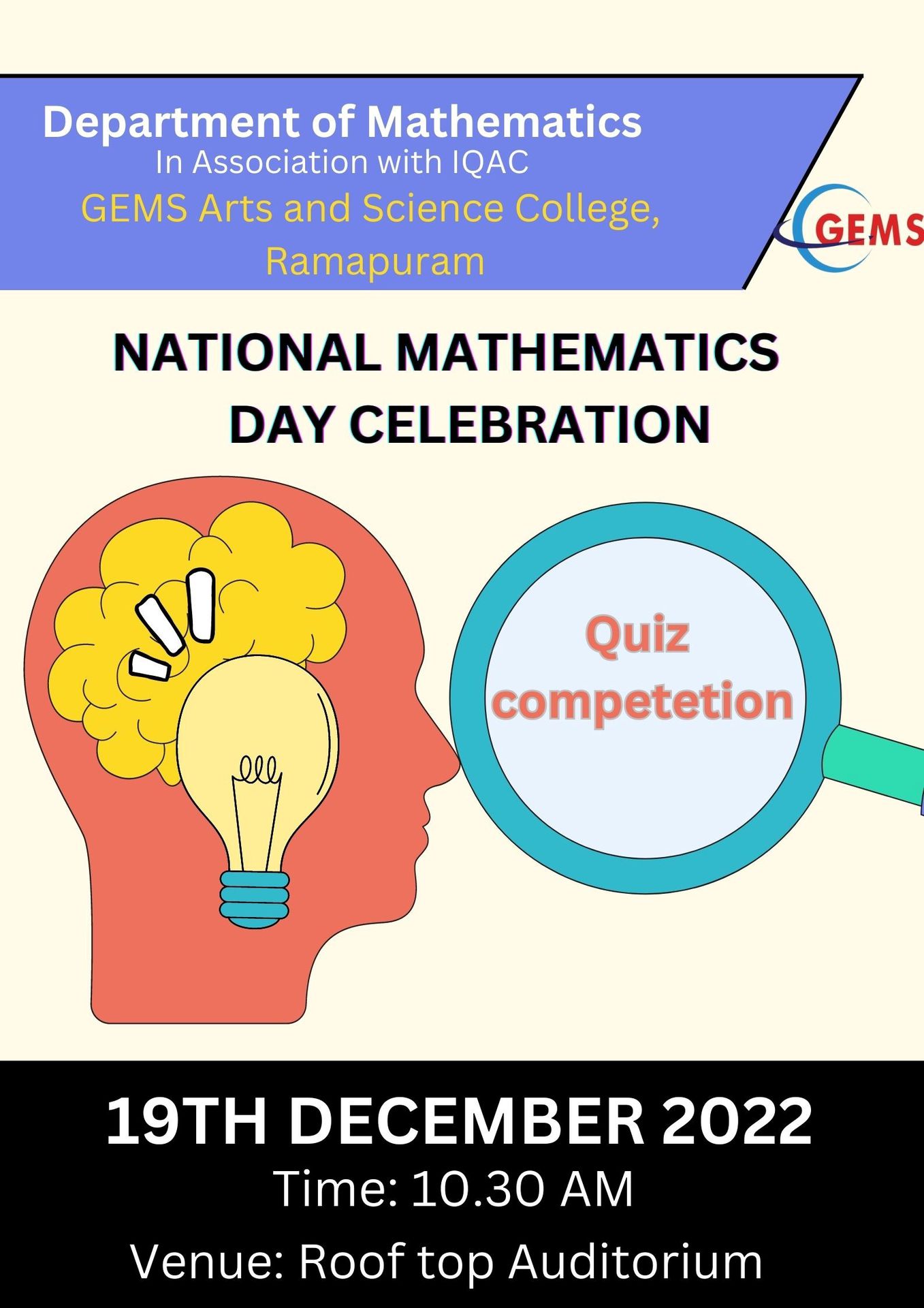
NATIONAL MATHEMATICS DAY
September 8, 2026
by
Gems College
Read Next
Mini Project Presentation 04-01-2022
The Department of Mathematics, in collaboration with the Internal Quality Assurance Cell (IQAC), conducted a mini-project presentation on the topic "Fibonacci Number" for second-year mathematics students on 04-01-2022. The objective of the presentation was to introduce students to the concept of the Fibonacci sequence and explore its applications in various fields. There were 43 participants were there. The session commenced with Thabsheera delivering an informative introduction to the Fibonacci number. She explained the origin of the sequence, its properties, and its significance in mathematics. Thabsheera's introduction set the stage for the subsequent presentations and created curiosity among the participants. Vishnu then took the stage and focused on the application of Fibonacci numbers in different contexts. He discussed the relationship between the Fibonacci sequence and the organs of the human body, highlighting the patterns and proportions found in nature. Furthermore, he explored the presence of the Fibonacci series in music and its contribution to creating harmonious compositions. Vishnu's presentation demonstrated the wide-ranging impact of Fibonacci numbers across diverse fields. Continuing the exploration of Fibonacci numbers, Vishnu discussed their connection to Pascal's triangle. He explained how the Fibonacci sequence can be observed within Pascal's triangle, revealing a hidden pattern. This presentation showcased the interplay between different mathematical concepts and further deepened the participants' understanding of the Fibonacci number. Muhsin took the opportunity to explain the fundamentals of the Fibonacci sequence. He provided a clear definition and discussed the iterative nature of the sequence, emphasizing the mathematical relationship between consecutive terms. Muhsin's presentation ensured that all participants had a solid grasp of the basics before moving on to more complex applications. Building on the previous presentations, Sufaid focused on the occurrence of Fibonacci sequences in natural phenomena. He specifically explored the presence of Fibonacci numbers in sunflowers, highlighting the spiral patterns observed in their seeds and flower petals. Sufaid's presentation demonstrated the prevalence of Fibonacci sequences in the natural world and the mathematical principles underlying these phenomena. Continuing the discussion on natural occurrences, Sufaid then presented on the presence of Fibonacci sequences in seashells. He showcased various examples of seashells exhibiting spirals that adhere to the Fibonacci pattern. This presentation further reinforced the concept of Fibonacci numbers in nature and their connection to mathematical principles. The session concluded with Thabsheera summarizing the key points covered in the presentations. She highlighted the significance of the Fibonacci sequence in various fields and reiterated the importance of understanding this fundamental mathematical concept. Thabsheera's conclusion provided closure to the session and encouraged the participants to explore further applications of Fibonacci numbers. Overall, the mini-project presentation on the Fibonacci number was a valuable learning experience for the second-year mathematics students. It introduced them to the concept of the Fibonacci sequence and showcased its diverse applications in fields such as biology, music, and natural phenomena. The presentations highlighted the interdisciplinary nature of mathematics and its relevance in understanding patterns in the world around us. The event was a testament to the department's commitment to providing a comprehensive mathematical education and fostering a deep appreciation for mathematical concepts among the students.