ഞങ്ങളും കോളേജിലേക്ക്
Gallery
Placement Cell
Gems.ai
Careers
NIRF | KIRF
Accreditations
Login
GEMS Arts & Science College - Autonomous
Ramapuram, Malappuram
GEMS Arts & Science College
Accredited By NAAC A++ Grade
Admission Open
Home
About Us
College Profile
Evolution of GEMS
Chairman’s Message
Principal's Message
Academic & Research Director Message
Board of Directors
College Council
Code of Conduct
Organogram
Academic & Research Review Committee
Academics
Programmes
Swayam - NPTEL
Add-On Courses
AI Training Programmes
Academic Calendar
OBE
Programmes
UG Programmes
PG Programmes
Departments
Dept. of Biotechnology
Dept. of Computer Applications
Dept. of Computer Science
Dept. of Commerce
Dept. of English
Dept. of Geology
Dept. of Languages
Dept. of Management Studies
Dept. of Microbiology
Dept. of Multimedia
Dept. of Physical Education
Dept. of Social Work
Dept. of Sociology
Dept. of Travel & Tourism
Explore every department and unlock Diverse Learning Opportunities.
View All Departments
Research
Research Policies & Committe
Research Publication
Examination
Controller of Examinations
Notifications
Registrations
Time Tables
Seating Arrangements
Exam Results
Exam Grivances
Student Zone
Statutory Cells
Clubs & Forums
NSS
Placement Cell
Committees
Alumni
Statutory Cells
Anti - Ragging Cell
ICC (ASHC)
SC/ST Equal Opportunity
Grievance Cell
OBC & Minorities
Clubs & Forums
Nature Club
Literary Club
Charity Club
Tourism Club
Staff Recreation Club
Photography Club
Adventure Club
Electronical Literacy Club
Campus Life
Facilities
News & Events
Virtual Tour
Video Gallery
Facilities
Practical Learning Hubs
Sports Hub
Amenities
IQAC
IQAC
Objectives & Functions
IQAC Composition
Quality Initiatives
Quality Policies
Best Practices
Strategic/Prospective Plans
IQAC Minutes & Reports
NAAC
Feedback & Report
Annual Reports
Academic & Audit Committee
Student Satisfaction Survey
ഞങ്ങളും കോളേജിലേക്ക്
Gallery
Placement Cell
Gems.ai
Careers
NIRF | KIRF
Accreditations
ERP Login
News & Events
Home >
Campus life >
News & Events
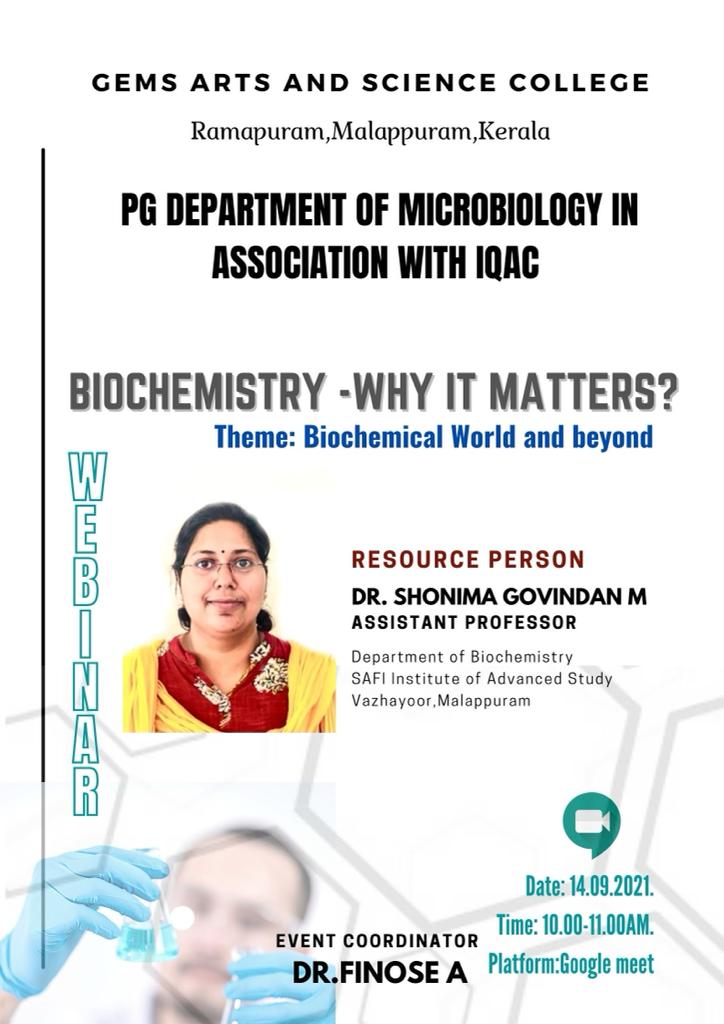
Biochemistry-Why it matters?
September 8, 2026
by
Gems College
Read Next
PLASTICS A BLESSING OR CURSE TO MANKIND
In association with IQAC, the PG Department of Microbiology was conducted a webinar on the topic ‘Plastics: a blessing or curse to mankind’ on 8th September 2021 at 2pm-3pm.The Speaker of the webinar was Nithya Jayan, Assistant Professor, SN College Alathur. The webinar was very interesting and informative for both students and faculties. Radhika R Krishna, Head of the department of microbiology performed the welcome speech. In the introductory section the speaker explained about types and structure of plastic and its uses and drawbacks. She led a very interesting class on bioplastics too. The microbial remediation system and biodegradation methods of plastic were also well explained. Each and every topic were further more interesting as it approached the biodegradation methods of plastic. A qualitative analysis of enzymes involved in the biodegradation and a detailed class on its mechanisms were the highlights of the webinar. A vision on the hazardous effects of plastic to the environment was emphasised and it generated the serious concerns regarding this major problem in every participants mind. The waste management is the biggest threat to our sustainability. She explained about recycling, reuse and reduce principles of plastic. In this era, we have to focus on biodegradable plastics and the trending one is bio-plastic “a new gen plastic”. Bioplastics are plastic derived from renewable biomass sources, such as vegetable fats and oils, corn starch, or micro biota, and other bio wastes. Here we are focusing on synthesis of bio-plastic from bio- wastes such as sugarcane baggase and mixture fruit pulp which includes jackfruit, banana peel, mango, nutmeg, duranian seeds. The use of bioplastics offers significant advantages not only in an ecological sense but also in an economical sense. Types of Bioplastics are Starch-based plastics ,Cellulose-based plastics, Polylactic acid (PLA) ( a transparent plastic produced from cane sugar or glucose), Poly-3-hydroxybutyrate (PHB) ( a polyester produced by certain bacteria processing glucose, corn starch or wastewater and Bio-derived polyethylene. After a brief interactive session, the programme was ended with the vote of thanks delivered by Shahana.P, a student of S3 B.Sc Microbiology. A total of 60 students attended the webinar.